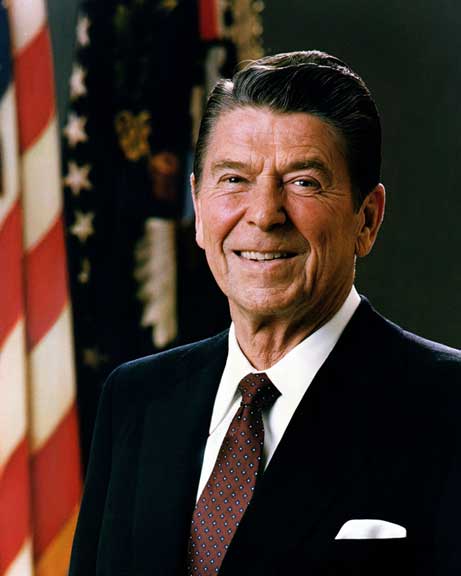
In office January 20, 1981 — January 20, 1989 · Republican
A former actor and 'Great Communicator,' Reagan cut taxes, built up the military, and pressed the Soviet Union until the Cold War began to thaw — surviving an assassination attempt and reshaping American conservatism. Elected 1980 →
Born
Feb 6, 1911Tampico, IL
Died
June 5, 2004Los Angeles, CA
Party
Republican
Vice President
George H. W. Bush
First Lady
NancyReagan
War
None
Ronald Reagan
Reagan was named "the great communicator." He oversaw the largest peacetime increase in defense spending, as well as the largest single tax cut in American history. His conservative view would set new norms for a President. Elected 1980, Elected 1984
Watch — Ronald Reagan in brief
The Early Years
Ronald Reagan was born in Tampico, Illinois. He grew up in a lower-middle-class environment and attended public schools, where he was an average student.
From 1928 to 1932, he attended Eureka College, where he played on the football team, having received a partial football scholarship. In 1932, Reagan began his radio career as a sports broadcaster for station WOC in Davenport, Iowa. In 1937, he left radio to pursue a career in Hollywood. Reagan starred in a string of B movies and, by World War II, had become one of Hollywood’s leading actors. During the war, he served in supply units and later worked on films produced for the Air Force.
In 1947, Reagan became president of the Screen Actors Guild. In his early years, he was an active Democrat, but in 1952 he joined the Democrats for Eisenhower campaign. By 1960, he was working actively for the election of Richard Nixon. In 1962, Reagan formally joined the Republican Party.
In 1966, Reagan was elected governor of California. During his eight-year tenure, he established a conservative record. His two greatest achievements were restoring fiscal stability to California’s budget and implementing welfare reform.
In 1968, Reagan made an attempt to secure the Republican nomination for president, finishing third behind Richard Nixon and Nelson Rockefeller. In 1976, he challenged President Ford for the party’s nomination but fell short by just 60 votes. In 1980, Reagan finally received the nomination for the presidency.
Accomplishments in Office
Here’s the improved version with grammatical corrections:
Ronald Reagan's presidency was dominated by two major themes: rigorously opposing the Soviet Union and promoting the idea that "less government is best." Reagan believed that the United States had to resist Soviet expansion and strengthen its defenses. He strongly advocated for the development of the Strategic Defense Initiative (SDI), a missile defense system designed to protect against attacks.
Reagan successfully led the United States through a massive arms buildup, which many believe contributed to the Soviet Union's decision that it could no longer afford to compete and was falling behind. This led to the beginning of *Perestroika*, a series of reforms that loosened the Soviet state's grip on the economy. However, once control was loosened in a nation that had been held together by fear and coercion, an irreversible process began. The Soviet Union soon collapsed.
Early in his first term, Reagan famously fired striking air traffic controllers, breaking the power of their union. He also passed a massive tax reduction and reform package. While these policies helped stimulate the American economy, they also contributed to large deficits that continue to challenge the U.S. today. Known as the "Great Communicator," Reagan remained extremely popular throughout his presidency.
The Cabinet Secretaries of State: Alexander Haig, Jr. George Schultz Secretaries of The Treasury: Donald Regan, James Baker, Nicholas Brady Secretaries of Defense: Caspar Weinberger, Frank Carlucci Attorney Generals: William French Smith, Edwin Meese, Richard Thornburgh Secretaries of The Interior: James Watt, William Clark, Donald Hodel Secretaries of Agriculture: John Block, Richard Lyng Secretary of Commerce: Malcolm Baldridge, C. William Verity, Jr. Secretary of Labor: Raymond Donovan, William Brock, Ann Dore McLaughlin Secretaries of Health and Human Services: Richard Schweiker, Margaret Heckler, Otis Bowen Secretary of Housing & Urban Dev.: Samuel Pierce Secretaries of Transportation: Andrew Lewis, Elizabeth Dole, James Burnley Secretaries of Energy: James Edwards, Donald Hodel, John Herrington Secretaries of Education: Terrel Bell, William Bennett, Lauro Cavazos
Did You Know? First President to be born in Illinois.
From the makers of HistoryCentral
Explore our history apps
Take HistoryCentral with you. Our apps put American history and centuries of the human story in your pocket.