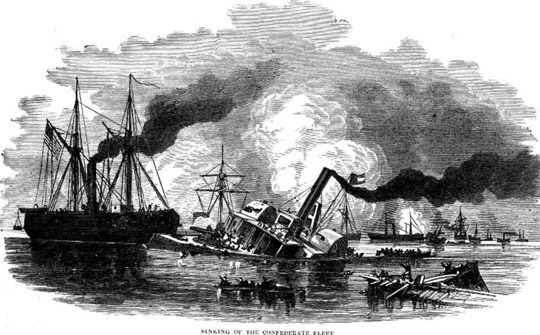
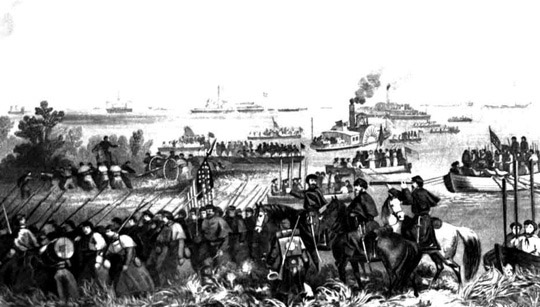
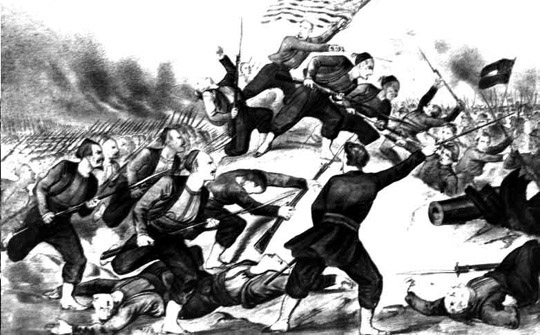
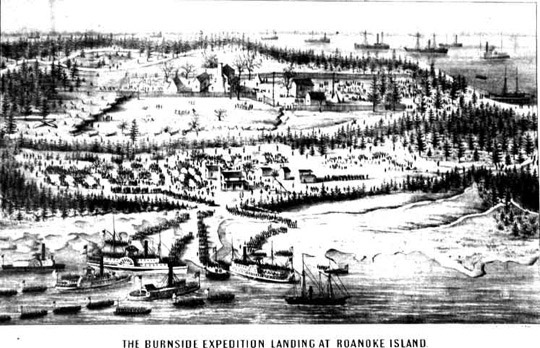
The Union gave the capture of Roanoke Islands a high priority. Brigadier General Ambrose Burnside commanded 11,500 men who embarked in a fleet of 65 ships commanded by flag officer L. M. Goldsborough. On February 7th the fleet came up to Pamilco Sound. The warships steamed up first steaming close to the western shore of the channel. The Union fleet made short order of the small Confederate fleet, quickly sinking the CSS Curlew. The fleet also made short order of the nearest Confederate Fort- Fort Bartow. As the bombardment was taking place, Burnside put his forces ashore on the southern end of the island. The Confederates had 1,500 men dug in along a defensive line in the middle of the island. Burnside sent his men on a flanking maneuver through swamps. They were able to overwhelm the Confederate line. The Confederates withdrew to the north end of the island where they surrendered, thus giving the Union control of the island and soon the complete Carolina coastal waters.