 >
>The Evolution of Financial Control: From Banks to Personal Custody
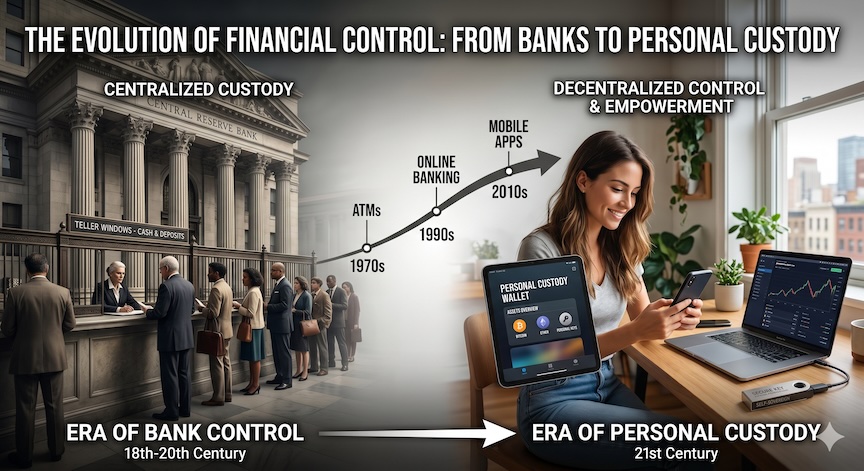
The Evolution of Financial Control: From Banks to Personal Custody
In early monetary systems, control over money was inseparable from physical possession. Coins, precious metals, and other forms of commodity-backed currency functioned as bearer assets: whoever held them exercised full authority over their use. There were no intermediaries required to validate ownership or authorize transactions. Exchange occurred directly, and trust was embedded in the physical nature of money itself.
This model made control immediate and unambiguous. Individuals did not depend on external systems to access or transfer value. Ownership was visible, transferable through simple exchange, and independent of any institutional framework.
At the same time, this structure imposed practical limits. Storing large amounts of value created ongoing security risks, especially in unstable environments. Transporting money across distances was inefficient and often dangerous. As trade expanded and economies became more interconnected, these constraints made direct ownership increasingly difficult to maintain at scale.
The Rise of Banking and Institutional Control
As economic systems grew in size and complexity, the limitations of physical money became more than an inconvenience they became a barrier to further development. Expanding trade networks required more reliable ways to store value, move it across regions, and settle transactions without constant exposure to loss or delay. Financial institutions emerged as a response to these pressures, offering a structured alternative to direct ownership.
Banks introduced a model in which individuals no longer needed to hold money themselves. Instead, value could be deposited, recorded, and transferred through institutional systems. This allowed transactions to occur without the physical movement of assets, making economic activity more efficient and scalable.
The Need for Secure Storage and Transfer
One of the primary drivers behind this shift was the need to reduce risk. Holding physical wealth exposed individuals to theft, damage, and logistical challenges. By centralizing storage, banks provided a more secure environment, supported by physical safeguards and later by legal and regulatory frameworks.
This system also simplified long-distance transactions. Rather than transporting money, individuals could rely on institutional mechanisms to transfer value between accounts. This reduced friction and made it possible to sustain larger and more complex trade relationships.
Ownership Becomes Institutional
The introduction of custody fundamentally changed how control over money was structured. While individuals still owned their funds in a legal sense, they no longer exercised direct control over them. Access became dependent on institutional processes, including verification, authorization, and compliance with established rules.
This created a new balance between security and autonomy. Financial systems gained stability and scale, but individuals relinquished immediate control in exchange. Ownership was no longer defined by possession, but by a claim recognized and maintained within an institutional framework.
Digital Banking and the Illusion of Access
The transition to digital banking did not replace the institutional model of control it refined its interface. As financial systems moved online, users gained the ability to interact with their accounts in real time. Balances could be checked instantly, transfers executed within seconds, and financial activity monitored continuously. On the surface, this created a sense of direct engagement with one’s money.
However, this shift was largely representational. Digital platforms function as access layers built on top of existing institutional infrastructure. The underlying structure where control is mediated by centralized systems remains unchanged. What appears as immediate control is, in practice, permissioned interaction with systems that define and enforce the rules of access.
Access Without Control
The distinction between access and control becomes clearer when examining how digital accounts operate. Users can initiate transactions, but those actions are always subject to validation by the institution. Funds are not moved independently by the user; they are reassigned within a system that the user does not control.
This means that access can be modified or restricted. Accounts can be limited, transactions can be blocked, and services can be suspended based on internal policies or external requirements. The user experience suggests autonomy, but the underlying mechanics preserve institutional authority.
Hidden Dependence on Infrastructure
Digital banking also introduces layers of dependency that are less visible than in earlier systems. Access relies on authentication mechanisms, network availability, regulatory compliance, and the operational integrity of financial institutions. When any of these layers fail or are interrupted, the ability to use funds is affected.
This dependence is often obscured by the efficiency of modern interfaces. Under normal conditions, systems operate seamlessly, reinforcing the perception of control. But structurally, the model remains consistent with earlier forms of institutional custody: ownership is mediated, and control is contingent.
The Return of Direct Control in Digital Form
The emergence of blockchain-based systems introduced a different approach to financial control – one that operates outside traditional institutional frameworks. Instead of relying on centralized entities to record and authorize transactions, these systems use distributed networks where control is defined by cryptographic proof rather than institutional recognition.
This model reestablishes a form of direct ownership in a digital context. Assets are not held by an intermediary but are associated with addresses on a network, accessible through specific credentials. Control depends on whether a user can demonstrate authority over those credentials, not on whether an institution grants permission.
Digital Bearer Assets
In this structure, digital assets function similarly to bearer instruments, but without the physical constraints of earlier systems. They can be transferred globally without requiring trusted intermediaries, and their ownership is determined by network consensus rather than centralized record-keeping.
This reintroduces a concept that had largely disappeared from modern finance: the ability to hold and transfer value independently of institutional systems. The difference lies in the medium. Instead of physical possession, control is expressed through cryptographic access
Private Keys as a Control Mechanism
The mechanism that enables this model is the private key. It is not simply a security feature but the foundation of ownership itself. Whoever controls the key can authorize transactions, access assets, and maintain custody without external approval.
This shifts responsibility as well as authority. The safeguards traditionally provided by institutions such as recovery systems or fraud protection are not inherently part of this model. Control becomes absolute, but so does accountability. The user is no longer dependent on an institution, but is also no longer protected by one.
Wallets as Interfaces in a Layered Financial System
As digital asset systems expanded, the infrastructure supporting them became more complex. Early blockchain environments were relatively simple: users interacted with a single network, and the primary challenge was managing access credentials. Over time, however, new layers were introduced to improve scalability, reduce transaction costs, and support a broader range of applications. This created a more dynamic but also more fragmented environment.
Within this structure, the role of the wallet began to change. It was no longer sufficient for a wallet to simply store keys and display balances. Users needed a way to move between networks, interact with different layers, and manage multiple types of transactions without navigating the underlying technical complexity directly. The wallet became the primary interface through which this interaction takes place.
From Storage to Interaction
This shift reflects a broader change in how financial control is exercised. In earlier models of self-custody, control was closely tied to the act of holding access credentials. In layered systems, control also involves the ability to operate within an evolving environment connecting to applications, approving interactions, and managing assets across different network layers.
As a result, the wallet functions less as a passive container and more as an active coordination layer. It translates user intent into actions within the system, allowing individuals to engage with infrastructure that would otherwise remain inaccessible. Control is still retained at the level of ownership, but it is expressed through increasingly sophisticated interfaces.
Navigating Layered Networks
The introduction of additional layers changes not only performance characteristics, but also the pathways through which users access and manage their assets. Transactions may occur on different layers depending on speed, cost, or application requirements. This requires tools that can abstract complexity while preserving user control.
Modern implementations reflect this evolution. A base wallet, for example, operates within a layered environment where users can manage assets and interact with systems designed to extend the capabilities of underlying networks. In this context, the wallet is not defined solely by storage, but by its ability to provide coherent access across multiple layers while maintaining the principle of self-custody.
A New Balance Between Control and Convenience
The historical trajectory of financial systems has been shaped by a recurring tension between control and convenience. Early systems prioritized direct ownership but struggled with scale and security. Institutional models improved efficiency and reduced risk, but required individuals to relinquish immediate control. Digital banking enhanced accessibility while preserving the same underlying dependencies.
The emergence of self-custody and layered infrastructure does not eliminate this tension it reframes it. Users can now retain direct control over their assets while operating within systems designed for global scale and real-time interaction. At the same time, this model introduces new forms of complexity and responsibility that were previously managed by institutions.
Rather than resolving the trade-off, modern financial systems redistribute it. Control becomes more accessible, but it requires greater awareness and participation. Convenience improves, but often depends on tools that abstract increasingly sophisticated infrastructure. The balance between these forces continues to evolve, reflecting a broader historical pattern in which each stage of financial development reshapes, rather than removes, the relationship between ownership and control.