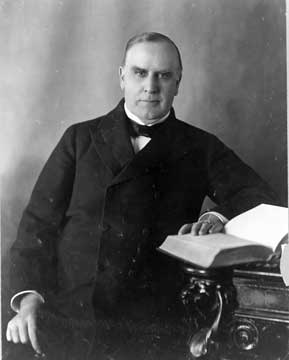
In office March 4, 1897 — September 14, 1901 · Republican
McKinley led the nation to victory in the Spanish–American War, acquiring an overseas empire from Cuba to the Philippines, and presided over returning prosperity. He was assassinated by an anarchist early in his second term. Elected 1896 →
Born
Jan 29, 1843Niles, OH
Died
Sep 14, 1901Buffalo, NY
Party
Republican
Vice President
Garret Hobart · Theodore Roosevelt
First Lady
IdaMcKinley
War
Spanish–American War1898
William McKinley
William McKinley presided over a transitional preiod in American history. During his tenure, America became a world power for the first time. It fought and won the Spanish-American War, gaining the Philippines and Puerto Rico as territories.. Elected 1896 Elected 1900
Watch — William McKinley in brief
The Early Years
McKinley was born in Niles, Ohio. When he was ten his family moved to Poland, Ohio ten miles away. McKinley attended public schools in Poland and in 1852 he enrolled in Ohio's Poland Seminary. At the age of 17, McKinley enrolled in Allegheny College in Meadville, Pennsylvania. He dropped out due to illness. In June of 1861, McKinley enlisted as a private in the Union Army. He rose to the rank of Brevet Major. One of his commanders was Rutherford Hayes, who rated McKinley's actions as a soldier highly.
After his return from the army, McKinley studied law and was admitted to the bar in 1867. From 1877 to 1883, and then again from 1885 to 1891, McKinley served as a Republican in the House of Representatives. He was known as the foremost proponent of protectionist legislation. He favored a high tariff to keep out imports. From 1892-1896, McKinley served as Governor of Ohio.
Accomplishments in Office
Upon assuming the Presidency, McKinley made a significant move by calling a special session of Congress to pass the Dingley Tariff Act. This act, which raised tariffs to a new high, had a profound impact on the nation's economy and trade relations.
McKinley's Administration, however, will be best remembered for spanning the time that America moved onto the world stage as a major player. This took place primarily as a result of the Spanish-American War, a conflict that was heavily influenced by the press. The war, almost forced on the President by media pressure, resulted in the United States gaining possession of Puerto Rico, the Philippines and Guam. Spain capitulated and gave independence to Cuba - the stated goal of the war. In 1898, the same year as the Spanish-American War, McKinley approved the annexation of Hawaii.
With the end of the War and the United States clearly in a position of world power after roundly defeating the Spanish, McKinley pursued a strong open-door policy in China. This resulted in American forces participating in suppressing the Boxer Rebellion.
Throughout his Presidency, McKinley remained dedicated to his wife Ida, who suffered from epilepsy, hardly leaving her side. On September 6, 1901, at 4:07 p.m., while he was attending the Pan American Exposition in Buffalo, N.Y., McKinley was struck by an assassin's bullet. He died seven days later.
From the makers of HistoryCentral
Explore our history apps
Take HistoryCentral with you. Our apps put American history and centuries of the human story in your pocket.