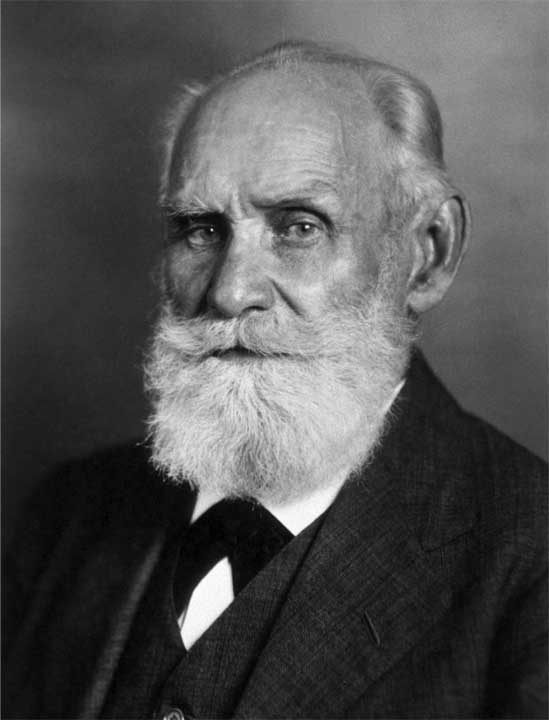
Ivan Pavlov was the Russian physiologist whose discovery of the conditioned reflex laid the foundations for the modern scientific study of learning and behavior. Born in Ryazan, the son of a village priest, he abandoned his early religious training for the natural sciences and rose to become one of Russia's most distinguished researchers, eventually heading the physiology department at the Institute of Experimental Medicine in St. Petersburg.
Pavlov first won renown for his meticulous studies of the physiology of digestion, work for which he was awarded the Nobel Prize in Physiology or Medicine in 1904. It was during this digestive research that he made his most famous observation: that the dogs in his laboratory began to salivate not only when fed but at signals they had learned to associate with food.
By systematically pairing a neutral stimulus — famously the sound of a bell or buzzer — with feeding, Pavlov demonstrated that an animal could be trained, or "conditioned," to salivate at the signal alone. This "classical conditioning" became a cornerstone of behavioral psychology and influenced thinkers far beyond his field.
Though Pavlov was openly critical of the Bolshevik regime, the Soviet government valued his international prestige and supported his research, building him a grand laboratory. He worked rigorously into his eighties, insisting on careful experiment over speculation, and died in Leningrad in 1936 — his name permanently attached to the idea of the conditioned response.