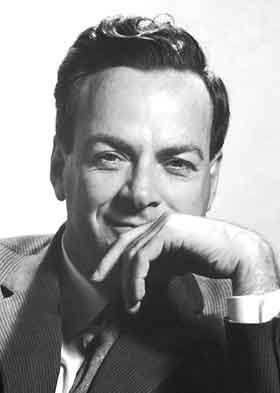
Richard Feynman was one of the most brilliant and original physicists of the twentieth century, as celebrated for his irreverent personality and gift for explanation as for his profound contributions to science. Born in Queens, New York, he showed a precocious talent for mathematics and physics and studied at MIT and Princeton.
As a young man during the Second World War he worked on the Manhattan Project at Los Alamos, where his brilliance and mischievous habit of cracking safes became legendary. After the war he developed the theory for which he is best known: quantum electrodynamics, the strikingly accurate description of how light and matter interact. His intuitive "Feynman diagrams" became an indispensable tool of modern physics, and the work earned him a share of the 1965 Nobel Prize in Physics.
A magnetic teacher, Feynman captivated students at Caltech, and his published lectures became classics that introduced generations to the beauty of physics. His popular memoirs, such as Surely You're Joking, Mr. Feynman!, revealed a restless, playful mind drawn to safecracking, bongo drums, and Brazilian samba as much as to science.
In 1986 he won national fame by serving on the commission investigating the Challenger space shuttle disaster, dramatically demonstrating before television cameras how a cheap rubber O-ring failed in cold water — pinpointing the cause of the tragedy. He died in 1988.