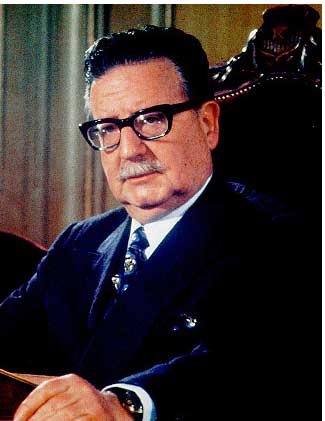
Salvador Allende was the Marxist president of Chile whose democratically elected socialist government was overthrown in a violent military coup, making him a martyr of the Latin American left and a symbol of the Cold War in the hemisphere. Born in Valparaíso to a middle-class family, he trained as a physician and entered politics, helping to found Chile's Socialist Party and serving for years as a senator and minister.
After several unsuccessful presidential campaigns, Allende won the election of 1970 at the head of a left-wing coalition, becoming the first avowed Marxist freely elected to lead a country in the Americas. He set out to build socialism by constitutional means — nationalizing the copper mines and major industries, redistributing land, and expanding social programs.
His government soon faced mounting troubles: economic chaos, soaring inflation, fierce opposition from the middle and upper classes, and the covert hostility of the United States, which worked to undermine him. Chilean society grew deeply and dangerously polarized.
In September 1973 the armed forces, led by General Augusto Pinochet, launched a coup. As troops stormed the presidential palace, Allende refused to surrender and died there — by most accounts taking his own life rather than be captured. His overthrow ushered in a long and brutal military dictatorship, and Allende's name became an enduring rallying cry for democracy and the left.