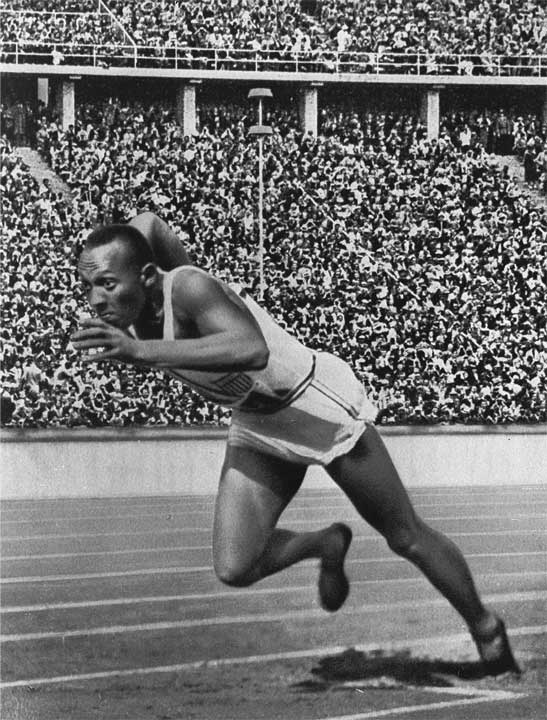
Jesse Owens was the American track-and-field star whose four gold medals at the 1936 Berlin Olympics made him a hero and dealt a stinging rebuke to Adolf Hitler's theories of Aryan racial supremacy. Born in Alabama, the grandson of slaves, he moved north as a child to Cleveland, Ohio, in the great migration of Black families, and there discovered his extraordinary gift for running and jumping.
As a college athlete at Ohio State University, Owens achieved one of the greatest single days in sports history: at a 1935 meet, in the span of about forty-five minutes, he set three world records and tied a fourth. The performance announced him as the finest all-around track athlete in the world.
His defining moment came at the Berlin Olympics of 1936, staged by the Nazi regime as a showcase for its ideology. Before Hitler and a vast German crowd, Owens won four gold medals — in the 100 meters, 200 meters, long jump, and relay — a triumphant display that contradicted the propaganda of racial hierarchy and made him a worldwide symbol.
Returning home, however, Owens faced the harsh realities of segregation and racial discrimination in his own country, and he struggled financially for years, taking on a variety of jobs and exhibitions. In time he became a celebrated public speaker and goodwill ambassador, and was honored with the Presidential Medal of Freedom. He died in 1980, remembered as one of the great Olympic champions.